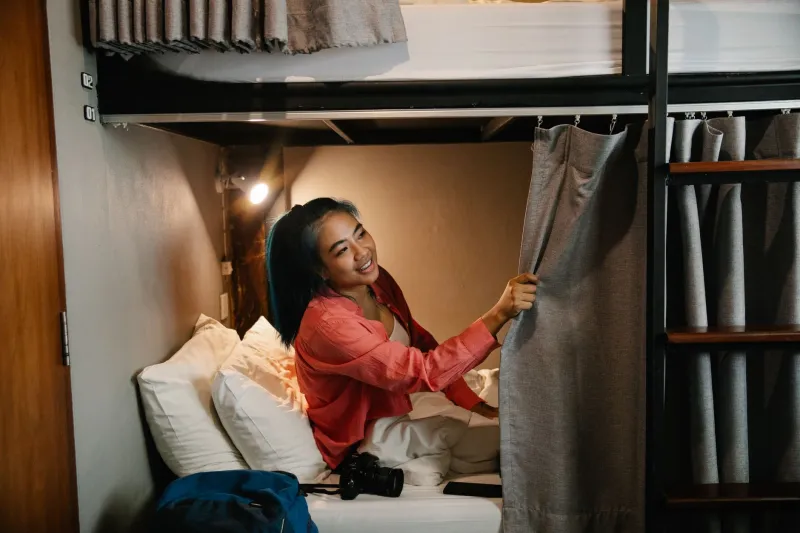
Checked In, Never Checked Out: The Americans Who Made a Hostel Their Permanent Address

Most people book a hostel bed the way they'd book a bus ticket — it's a means to an end, a cheap night between wherever you were and wherever you're going. But spend enough time at the right hostel and you start noticing the ones who aren't going anywhere. Their toiletries have migrated from a dry bag to a permanent shelf in the bathroom. They know which burner on the communal stove runs hot. They've got a favorite chair. They're not passing through. They live here.
This isn't some fringe phenomenon happening in one or two quirky spots. Across Southeast Asia, Central America, Southern Europe, and beyond, a quiet subset of American travelers has stopped treating hostels as a pit stop and started treating them as a primary residence. Call them hostel expats. Call them long-termers. Whatever the label, their numbers are growing — and their stories complicate everything you thought you knew about budget travel.
How It Starts (It's Never on Purpose)
Ask any long-term hostel resident how they ended up staying six months in a dorm in Medellín or a private room in Chiang Mai, and almost none of them will say they planned it. It usually begins the same way: they extended a two-week trip to a month, liked it, extended again, and eventually looked up one day to realize they'd built something resembling a life.
Take Marcus, a 31-year-old from Denver who started a three-week trip to Portugal in 2022 with a one-way ticket and a vague plan to "figure it out." Eighteen months later, he was still in Lisbon, splitting his time between two hostels in the Alfama district that he'd essentially adopted as home base. "I kept meaning to move on," he says. "But the math never made sense. A private room at the hostel was running me about $600 a month. A furnished apartment in the same neighborhood? Double that, minimum. And I didn't have to deal with leases, deposits, any of it."
That math — simple, brutal, undeniable — is the engine driving the whole thing.
The Negotiation Nobody Talks About
Here's what most travel content skips over: hostels negotiate. Not every one of them, and not always, but if you've been sleeping in the same building for three weeks and you're a low-drama guest who actually does their dishes, many hostel owners are open to a conversation about monthly rates.
The key, according to people who've done it successfully, is timing and approach. Don't ask at check-in. Don't ask on a weekend when the place is slammed. Wait until you've established yourself as someone the staff actually likes seeing. Then have a genuine conversation — not a demand, not a negotiation tactic. Just: Hey, I'm thinking about sticking around for a while. Is there anything we could work out?
Results vary wildly. Some travelers report discounts of 20 to 40 percent off the nightly rate for monthly commitments. Others get a private room bumped up in exchange for helping with social media or doing a few hours of front-desk coverage per week — a semi-formal arrangement that hostels often prefer to call "volunteer exchange" rather than employment, for obvious reasons.
Sophia, a 27-year-old from Austin who spent most of 2023 living in hostels across Mexico and Colombia, put together a patchwork of these deals that let her travel indefinitely on a remote customer service income of around $1,800 a month. "People hear that number and think it's impossible," she says. "But if your housing costs $500 and you're eating street food and local markets? You've got money left over. More than I had back home, honestly."
Building a Routine in a Rotating World
One of the stranger challenges of long-term hostel life is psychological. The whole environment is designed for transience. New faces every few days, goodbyes before you've finished learning someone's last name, the constant low hum of people arriving and departing. For short-term travelers, that energy is electric. For someone trying to build a stable daily rhythm, it can be quietly destabilizing.
The long-termers who seem to thrive are the ones who create structure within the chaos. A morning coffee ritual at the same café around the corner. A dedicated work block from 9 to noon before the common room fills up. A standing weekly dinner with whatever interesting people happen to be around that Thursday. Small anchors that give shape to days that would otherwise blur together.
"You stop trying to do everything with everyone," says Marcus. "You get selective. You become like the local at the hostel — the one people come to for recommendations, for advice on what neighborhoods to explore. It flips. You're not the tourist anymore. You're the person the tourists are talking to."
That shift in identity is something nearly every long-termer mentions. It's not quite expat, not quite tourist. Something in between — a category the travel industry hasn't fully named yet.
The Visa Reality Check
Here's where things get complicated, and where glossy travel content tends to look away. Living in a hostel long-term doesn't solve your visa situation — it just makes the housing piece cheaper while the legal piece remains exactly as thorny as it would be for any American living abroad without a formal residency arrangement.
Most Americans in this lifestyle are working with tourist visas, which typically cap out at 30, 60, or 90 days depending on the country. That means border runs — day trips or short hops to a neighboring country to reset the clock — or a rotation between countries timed to visa limits. It's a strategy, not a solution, and it comes with real risks. Some countries are cracking down on people who appear to be living on perpetual tourist visas. Getting flagged at the border, denied entry, or asked to show proof of onward travel is a real possibility.
The travelers navigating this most successfully are the ones who've done their homework — who know exactly what the rules are in each country they're in, who keep documentation of their income and travel history, and who don't push limits until they have a clear sense of how strictly things are enforced. It's not a system you want to learn through trial and error.
For those with remote income, digital nomad visas — now available in over 50 countries — offer a more sustainable path. But they come with their own requirements around minimum income thresholds and paperwork, and they don't always pair cleanly with hostel living, which tends to resist the kind of fixed-address documentation some visa applications require.
Is This a Life or a Long Vacation?
That's the question people back home keep asking, usually with a tone that's somewhere between impressed and concerned. And the honest answer is: it depends on who you ask, and probably on the week you ask them.
Some hostel long-termers are in a genuine transitional phase — figuring out what comes next, stretching a runway of savings while they build something portable. Others have been doing this for years and have no plans to stop. A few have quietly started to miss things they didn't expect to miss: a real kitchen, a bedroom door that locks, the low-grade comfort of knowing your neighbors' names.
But most of them, when you press them, will tell you the same thing: they don't regret it. The hostel didn't just save them money. It gave them a different relationship with the concept of home — looser, more provisional, less dependent on square footage and zip codes.
At Drifter Jack's, we've always believed that the best travel doesn't just take you somewhere new. It changes what you think is possible. For the hostel expats, the dorm room wasn't the destination. It was the doorway.